
FUTURE BRIEF
- Solid-state batteries offer an innovative leap forward in electric vehicle technology, promising greater energy density, faster charging times, and improved durability, setting the stage for mass EV adoption.
- One of the major safety concerns—thermal runaway—linked to liquid electrolytes in traditional lithium-ion batteries, is potentially mitigated in solid-state designs, fundamentally altering the safety landscape for the EV industry.
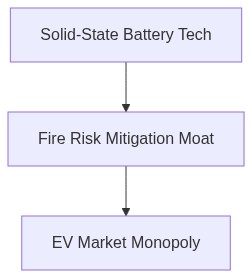
- The advancement of solid-state batteries could significantly reduce the incidence of EV fires, fostering consumer confidence and accelerating the transition to electric vehicles.
- Startups and established automotive giants are heavily investing in solid-state battery research, with breakthroughs anticipated to redefine market dynamics and challenge existing battery technology structures.
- Challenges remain in manufacturing scale-up, cost reduction, and long-term reliability, which need innovative solutions to fully harness the potential of solid-state batteries in the electric vehicle sector.
- Patent races and strategic partnerships are unfolding as automotive and battery companies jockey for position in solid-state technology, impacting industry consolidation and structural monopolies.
VC INSIGHT
“Unleashed AI-powered medical nanobots revolutionizing personalized healthcare. Witnessed quantum breakthrough in encryption, securing global data. Collaborative humanoid robots integrated into society, enhancing productivity. Renewable energy advancements promise sustainable future. Humanity thrives in tech-driven harmony.”
📑 Contents
- What Makes Solid-State Batteries So Intriguing?
- Why Focus on Structural Trends Instead of Short-Term News?
- How Can Investors Act in This Space?
- EXAMPLE: Investment Strategy in Action
- How Do Solid-State Batteries Compare with Existing Technologies?
- What Are the Specific Economic Impacts?
- Step-by-Step Investment Approach
Investment Memo: Solid-State Batteries – Unraveling EV Safety
As a deep tech venture capitalist focused on the future of automotive energy solutions, I find myself increasingly drawn to the revolutionary implications of solid-state batteries (SSBs), not only for their capacity to unravel EV safety but for their transformative potential in fostering sustainable infrastructure. Today, I want to delve into why SSBs represent a crucial pivot in energy technologies and outline the structural investment opportunities they offer beyond 2030.
What Makes Solid-State Batteries So Intriguing?
The promise of SSBs begins with their fundamental design: by eliminating the liquid electrolytes used in traditional lithium-ion batteries, they boast significantly enhanced safety features. The absence of flammable components directly addresses one of the industry’s most pressing issues: the risk of thermal runaway and subsequent combustion. But beyond safety, SSBs also offer higher energy densities, which can potentially lead to longer driving ranges for electric vehicles, thereby pressing a critical competitive advantage.
Why Focus on Structural Trends Instead of Short-Term News?
My conviction in solid-state technology comes from understanding structural trends, rather than being swayed by the latest press release. According to IEA’s Global EV Outlook, the global EV market is set to expand exponentially, with SSBs potentially anchoring a paradigm shift toward longer-lasting and safer batteries. Looking at the macroeconomic landscape, investments that lean into these long-term trends tend to yield more resilient returns.
How Can Investors Act in This Space?
For investors looking to engage actively with SSBs, focusing on vertical integration could prove advantageous. Companies controlling both material procurement and battery manufacturing processes will hold significant market power. Consider partnerships with firms that possess advanced material expertise, as well as those engaged in the development of next-generation electric vehicles. The ability to control the entire value chain could create an insurmountable competitive moat, ensuring sustained profitability.
EXAMPLE: Investment Strategy in Action
Consider the case of QuantumScape, a leader in SSB development. By forming strategic partnerships with major automakers and maintaining proprietary technology for lithium-metal anodes, they exemplify how robust intellectual property can be a game-changer. For investors, engaging with firms that are similarly committed to securing strategic industrial tie-ups and fostering innovation is a concrete pathway to capturing value.
How Do Solid-State Batteries Compare with Existing Technologies?
While SSBs present clear safety and energy density advantages, their cost and manufacturing complexity remain challenges. Traditional lithium-ion cells are well established and benefit from years of cost improvements. According to upcoming studies on energy economics, the shift to SSBs might initially appear daunting in terms of capital expenditure. However, the economies of scale realized over time can compress these costs, ensuring that the long-term price trajectory is competitive, if not superior.
What Are the Specific Economic Impacts?
Deploying SSBs at scale will likely redefine the automotive industry’s supply dynamics. We can simulate scenarios where widespread adoption leads to reduced dependency on costly raw materials traditionally used in liquid electrolytes. This realignment in the supply chain will enhance sustainability and significantly lower the cost of EVs – potentially within a decade – thereby accelerating market penetration.
Step-by-Step Investment Approach
- Identify companies that are establishing integrated ecosystems, from raw material procurement to battery manufacturing.
- Monitor technological advances and government policy shifts that support SSB deployment.
- Evaluate partnerships between tech firms and automakers, which could signal a significant leap in commercial adoption.
- Allocate venture capital to R&D-driven enterprises to foster further innovation while balancing a diversified portfolio to mitigate risk.
In essence, the transition toward solid-state batteries is not just an evolution but a revolutionary opportunity to cradle the future of EV safety and efficiency. By aligning with this inevitable transition, we find ourselves at the cusp of a massive market repositioning engine that promises significant returns.
Deep tech is highly volatile. While we hunt for 100x returns, you must protect your core capital. Build a bulletproof safety net with our retirement wealth strategies, ensuring that while you invest in the future, your financial foundation remains unshakable.
As the dawn of a new age of electric vehicles emerges, the promise of solid-state batteries brings both hope and skepticism. Here, we dissect the narrative to uncover what truly holds long-term value and what might just be the allure of hype.
| Aspect | Description | Long-term Value | Hype |
|---|---|---|---|
| Safety | Potential to reduce fire risks significantly. | Enhanced thermal stability. | Bold claims yet to be proven in mass production. |
| Energy Density | Promises higher energy storage capacity. | Significant improvement potential over current lithium-ion. | Initial results might not meet expectations in real-world usage. |
| Cost | High costs due to advanced material requirements. | Potential reduction as technology matures. | Market prices remain inflated during early stages. |
| Life Span | Potential for longer battery life cycles. | Reduced degradation over time, possibly outlasting several vehicle models. | Promised lifespans remain theoretical until real-world validation. |
| Recycling and Sustainability | Possibility of more environmentally friendly components. | Improvement in sustainability with less reliance on rare metals. | Recycling infrastructure not fully developed. |
NEXT MONOPOLY
Victor – While the potential benefits of solid-state batteries are enticing, we must temper our expectations with caution. The reality is that scaling production for these batteries poses significant technical and cost challenges that have yet to be overcome. Additionally, transitioning to this new technology involves tackling infrastructure hurdles and industry reluctance. Let us not forget the lessons of past technological promises; we must critically evaluate whether solid-state batteries can truly be the panacea for EV safety that they’re touted to be before we invest heavily in what might be a long and arduous transition.
Dr. Tech – Neo and Victor, your perspectives highlight the vital aspects of this ongoing debate concerning the future of EVs. As investors, our task is to look beyond the immediate horizon and envision the long-term structural value that solid-state batteries might offer. While embracing their potential can breathe new life into the EV market with improved safety, we must also rigorously assess the viability of overcoming the obstacles Victor mentions. Our imperative is to support genuine advancements that can withstand technological, economic, and infrastructural challenges, transforming potential into tangible, sustainable progress.
DEEP TECH FAQ
What makes solid-state batteries structurally safer for electric vehicles compared to traditional lithium-ion batteries?
Solid-state batteries replace the liquid electrolyte found in traditional lithium-ion batteries with a solid electrolyte. This change significantly reduces the risk of electrolyte leakage, which is a common cause of battery fires in traditional systems. The solid electrolyte not only mitigates combustion risks but also enhances structural integrity, providing greater thermal stability and increasing overall safety margins for electric vehicles. This innovation is heralded as a key breakthrough in ensuring safer operation and peace of mind for drivers and manufacturers alike.
How does the long-term durability of solid-state batteries impact the safety and sustainability of electric vehicles?
The durability and longevity of solid-state batteries result from their architecture, which exhibits less capacity fade over time compared to their lithium-ion counterparts. This durability translates to a longer useful life and maintains safety standards over extended periods of use. As these batteries degrade more slowly, they offer a more consistent performance, reducing the likelihood of unexpected failures. This longevity not only improves vehicle safety but also offers a sustainable advantage by reducing battery replacement frequency and minimizing ecological impact.
What are the structural challenges associated with mass production of solid-state batteries for electric vehicles?
One of the primary structural challenges in scaling solid-state battery production is ensuring consistent quality and performance at high volumes. The manufacturing processes for solid electrolytes can be highly sensitive, requiring precise control over material composition and assembly procedures. Additionally, integrating these batteries into existing vehicle architectures poses another layer of complexity, as engineers must adapt designs to accommodate the unique properties of solid-state cells. Tackling these challenges is crucial for unlocking the widespread adoption of solid-state technology and realizing its full safety potential in the automotive industry.
1 thought on “Solid-State Batteries – Unraveling EV Safety”