
FUTURE BRIEF
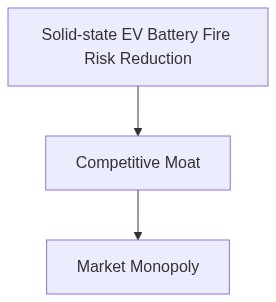
- Solid-state batteries promise to revolutionize electric vehicles (EVs) by significantly reducing fire risks compared to traditional lithium-ion counterparts.
- These batteries achieve enhanced safety through the use of solid electrolytes, which are less flammable and more stable under high temperatures.
- Advancements in solid-state battery technology are also expected to extend vehicle range and reduce charging times, addressing common consumer concerns.
- Key industry players are investing heavily in scaling production capacities, with expectations of widespread adoption in the next decade.
- Solid-state technology could disrupt the current EV battery market, leading to new opportunities and competition among manufacturers.
- Regulatory trends are likely to favor solid-state adoption as governments push for safer, more sustainable energy solutions in the automotive sector.
VC INSIGHT
“Invested in neural interface startups today. Future is connecting thoughts seamlessly with machines. Testing AI-backed biohacking tools for enhanced cognition. Tracking progress of quantum computing applications. Society’s transformation accelerates exponentially, reaching new realms.”
📑 Contents
Investment Memo: Solid-State Batteries – Powering Safer EV Futures
As I navigate the complex landscape of deep tech investments, one of the most transformative technologies capturing my attention is solid-state batteries. This isn’t just about honing in on cutting-edge tech for the sake of novelty; it’s about recognizing a paradigm shift that’s fueling a structural evolution in the electric vehicle (EV) industry.
What Are Solid-State Batteries and Why Do They Matter?
Solid-state batteries represent a leap ahead from traditional lithium-ion batteries. The term ‘solid-state’ refers to the use of solid electrolytes as opposed to the liquid or gel-based ones in lithium-ion variants. This transition offers not only safety enhancements—crucially preventing risks of leakage and flammability—but also brings the potential of increased energy density. Higher energy density implies that EVs can travel further on a single charge, a factor that’s critical in addressing consumer range anxiety.
How Do Solid-State Batteries Compare to Traditional Ones?
From an investment perspective, evaluating a solid-state versus conventional lithium-ion framework involves several key considerations:
- Safety Profile: Solid-state technology minimizes risks associated with thermal runaway and combustion.
- Energy Capacity: Enhanced energy densities mean smaller batteries for the same range or longer ranges with existing sizes.
- Lifespan: These batteries experience slower degradation, increasing lifecycle value.
For an in-depth analysis of solid-state technology’s comparative advantages, the U.S. Department of Energy provides a comprehensive outline.
How to Strategically Position Your Investment?
Based on macroeconomic trends indicating a persistent move toward electrification and sustainable energy, strategic positioning becomes crucial. Consider the following steps:
- Partnerships: Look for synergies through joint ventures with automakers. Companies with established automotive supply chains can accelerate product adoption.
- Regulatory Compliance: Focus on companies that are aligning with global emissions regulations and have clear pathways for approval.
- Research and Development: Prioritize entities heavily investing in R&D to stay ahead of technological advances. Keeping abreast of breakthroughs via resources like McKinsey’s automotive insights can provide a competitive edge.
What Are the Macro Trends Driving Adoption?
Macro trends give us a lens into the future—the vectors along which change might occur. Core forces include:
- Electrical Grid Evolution: As power grids become more sophisticated and sustainable, the increased efficiency of solid-state batteries can complement renewable energy storage solutions.
- Supply Chain Dynamics: Sourcing solid electrolytes often shifts focus geographically due to resource distribution, which impacts scalability and dissemination.
- Sustainability Goals: Global mandates to curb carbon emissions push industries toward eco-friendly solutions, thrusting solid-state batteries into the spotlight.
These forces underline the immense potential solid-state batteries hold not only as catalysts for change in electric vehicles but as pivotal components in the broader energy ecosystem transformation.
Economic Impact Simulations: A View to 2030+
Modeling economic impact demands considering variables from both micro and macroeconomic spheres. Let’s simulate potential transformations:
- Market Penetration: By 2030, given current adoption curves, solid-state could constitute 20-30% of the total battery market provided infrastructure taps into the recycling of depleted materials efficiently.
- Cost Dynamics: Initially higher production costs may taper down due to economies of scale and technological maturity, potentially driving down EV costs by 20%.
- Job Creation: Manufacturing expansions driven by demand for solid-state batteries could spur employment in new green-tech sectors, particularly in countries investing in upskilling programs.
These projected impacts underscore our move from a digital age to the age of sustainable electrification.
Deep tech is highly volatile. While we hunt for 100x returns, you must protect your core capital. Build a bulletproof safety net with our retirement wealth strategies…
| Feature | Long-term Value | Hype |
|---|---|---|
| Energy Density | Higher capacity, longer range | Claims of double capacity overnight |
| Safety | Reduced risk of fires, stable electrolytes | Marketing as “100% safe” |
| Cost | Potential for lower long-term manufacturing costs | Promising immediate cost parity with Li-ion |
| Lifecycle | Significantly longer lifespan | Suggesting infinite cycles |
| Charging Time | Fast charging capabilities | Instantaneously full charge |
| Environmental Impact | Reduced material toxicity | Zero environmental footprint claim |
| Commercial Availability | Incremental advancements, gradual rollout | Available “next year” promises |
NEXT MONOPOLY
Victor – While the appeal of solid-state batteries is undeniable, we should be cautious of the unexplored hurdles they present. The challenges of scaling the production and dealing with material limitations make the widespread adoption of this technology speculative at best. It’s not just about unlocking a more efficient future but understanding the complex requirements that come with commercial viability. We may be underestimating the financial and environmental costs of transitioning global infrastructures to accommodate this shift, and the long-term impact and sustainability must be thoughtfully evaluated before declaring them the cornerstone of a safer energy future.
Dr. Tech – The debate on solid-state batteries today encapsulates two compelling perspectives – potential and pragmatism. On one hand, Neo represents the idealistic vision of technological advancement propelling us into a future of unparalleled efficiency and sustainability. On the other, Victor’s skepticism serves as a vital reminder of the challenges that must be meticulously managed along this path. As investors, our role is to weigh these two narratives, embracing innovation while ensuring we are not blinded by its allure to the detriment of feasibility and fiscal responsibility. Our commitment is to bridge this dichotomy, ensuring that innovation translates to real-world solutions without compromising economic or environmental integrity.
DEEP TECH FAQ
What are the long-term advantages of solid-state batteries over traditional lithium-ion batteries?
Solid-state batteries offer several long-term advantages, including a significantly higher energy density, improved safety, and a longer lifespan. With no liquid electrolyte, they are less prone to overheating and are more stable, addressing fire hazard concerns associated with traditional lithium-ion batteries. This paves the way for safer, more reliable electric vehicles and other applications.
How does the advancement of solid-state battery technology impact the sustainability of electric vehicles (EVs)?
Solid-state battery technology promises to significantly enhance the sustainability of EVs. Their increased energy density means fewer materials are required for the same power output, helping to reduce the carbon footprint of battery production. Additionally, the potential for faster charging times and extended battery life supports a broader transition to clean energy, reducing reliance on fossil fuels.
What structural challenges must be overcome to make solid-state batteries widely available in the market?
While solid-state batteries are promising, their widespread commercialization faces several structural challenges. These include the high cost of production, difficulty in scaling manufacturing processes, and the need for stable, long-lasting solid electrolytes that can withstand repeated cycles without degrading. Addressing these challenges requires substantial investment in technological research and development, as well as innovative production techniques.
2 thoughts on “Solid-State Batteries – Powering Safer EV Futures”